Remote onboarding has to do more than transfer procedures. New hires need to understand how the organization works, meet the people around them, recognize its culture in practice, and prepare for the decisions their role requires.
Traditional onboarding video is usually one-way: a sequence of welcome messages, tours, and tutorials. Interactive video offers another model. It lets people explore, choose, respond, and practice instead of only watching.
The Remote Onboarding Challenge
Remote employees miss the informal interactions that build relationships and provide context. Culture is harder to observe, information can arrive without natural breaks, and the same generic path is often assigned to every role.
These structural weaknesses leave many remote new hires disconnected, overloaded, and slow to reach full productivity.
Interactive video changes the onboarding experience by shifting new hires from passive viewers into active participants. Instead of watching a sequence of recorded messages and tutorials, they explore, choose, and respond. That shift has practical consequences for connection, culture, and speed to productivity. Research from Harvard Business Review and Gallup consistently shows that early connection and clarity strongly influence whether remote employees stay and how quickly they contribute.
Exploring the organization · Meeting the team · Culture & values · Role-specific preparation
Exploring the organization
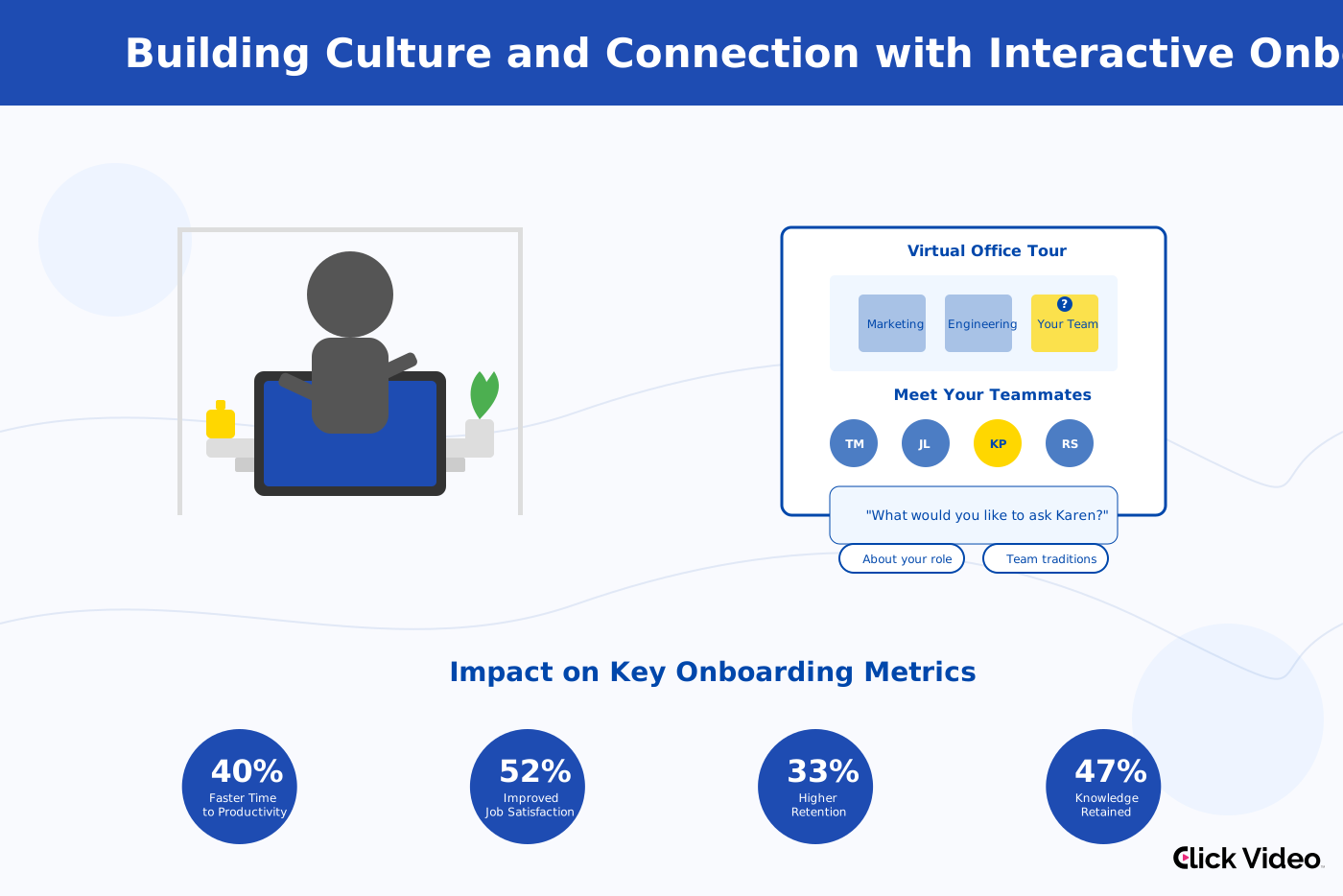
One of the clearest improvements comes in how people first encounter the organization. Traditional video tours simply show the office. Interactive versions let new hires move through spaces at their own pace, click into team areas to meet colleagues through short personal introductions, and discover cultural details embedded in the environment. The experience feels closer to walking the floor for the first time than watching a recording of it.
Meeting the team
The same principle applies to meeting the team. Rather than a series of one-way introduction videos, interactive formats can let new hires select questions, follow different conversational paths, and take part in light shared activities. The result is not just information about colleagues, but an early sense of familiarity. SHRM’s guidance on virtual onboarding emphasizes deliberate opportunities for connection.
Culture & values
Culture and values transfer also improves when people practice them instead of merely reading them. Scenario-based interactive video places new hires in realistic situations, shows the consequences of different choices, and prompts reflection. Abstract value statements become concrete decision frameworks that begin shaping behavior from the start.
Role-specific preparation
Finally, interactive systems support genuine role-specific preparation. Learning paths can adapt to the person’s role, prior experience, and demonstrated understanding. New hires practice in safe environments, receive targeted guidance, and build confidence without the risk of real-world mistakes. The effect is faster time-to-productivity and less of the overwhelm that often accompanies generic onboarding programs.
Taken together, these capabilities address the core weaknesses of conventional remote onboarding: weak connection, shallow cultural immersion, information overload, and one-size-fits-all content. The technology does not replace human relationships — it creates better conditions for those relationships to form.
A documented pharmaceutical training case history shows how interaction data can expose weak learning points while a program is still in progress. That same principle applies to onboarding: instrumentation should help the team improve the experience, not merely report that someone reached the end.
Key Elements of Successful Interactive Onboarding
While the specific content varies by organization, the most effective onboarding experiences have these characteristics in common:
1. Balanced Structure and Agency
Provide clear guidance while allowing new hires to make meaningful choices during their learning journey.
2. Progressive Information Delivery
Break information into manageable segments that build on previously established knowledge.
3. Natural Social Connection
Create opportunities for authentic interaction with teammates using leader-guided group conversations.
4. Meaningful Decision Points
Include scenarios where choices have consequences that reflect real workplace situations.
5. Personalized Learning Paths
Adapt content based on role, prior knowledge, and demonstrated level of understanding.
6. Actionable Analytics
Track engagement, comprehension, and areas of interest to inform follow-up and support. It’s normal for learning gaps to be identified and remediated in the first cohort of a new training program. See case history here.
Getting Started With Interactive Onboarding
Creating effective interactive onboarding experiences requires a unique blend of instructional design expertise, production capabilities, and technical implementation. There are platforms that provide some interactive video capabilities out of the box, with H5P being one of the more useful options for learning organizations.
The right approach depends on the interaction, integration, analytics, and production demands of the brief.
When evaluating potential approaches, consider these questions:
- Does the solution create genuine user choice or simply add clickable elements to standard videos?
- Can the experience adapt based on user choices and provide specialized knowledge?
- Does the solution incorporate realistic scenarios relevant to your learners?
- Will the implementation integrate with your enterprise systems and provide meaningful analytics?
- Is the finished product good enough to represent your brand to new hires?
Connect on Day One
Interactive video can create useful opportunities for connection and practice from day one, even when teams never meet in person.
Working on an onboarding brief for an agency client? Send the scope or request a private walkthrough of relevant interaction patterns.